
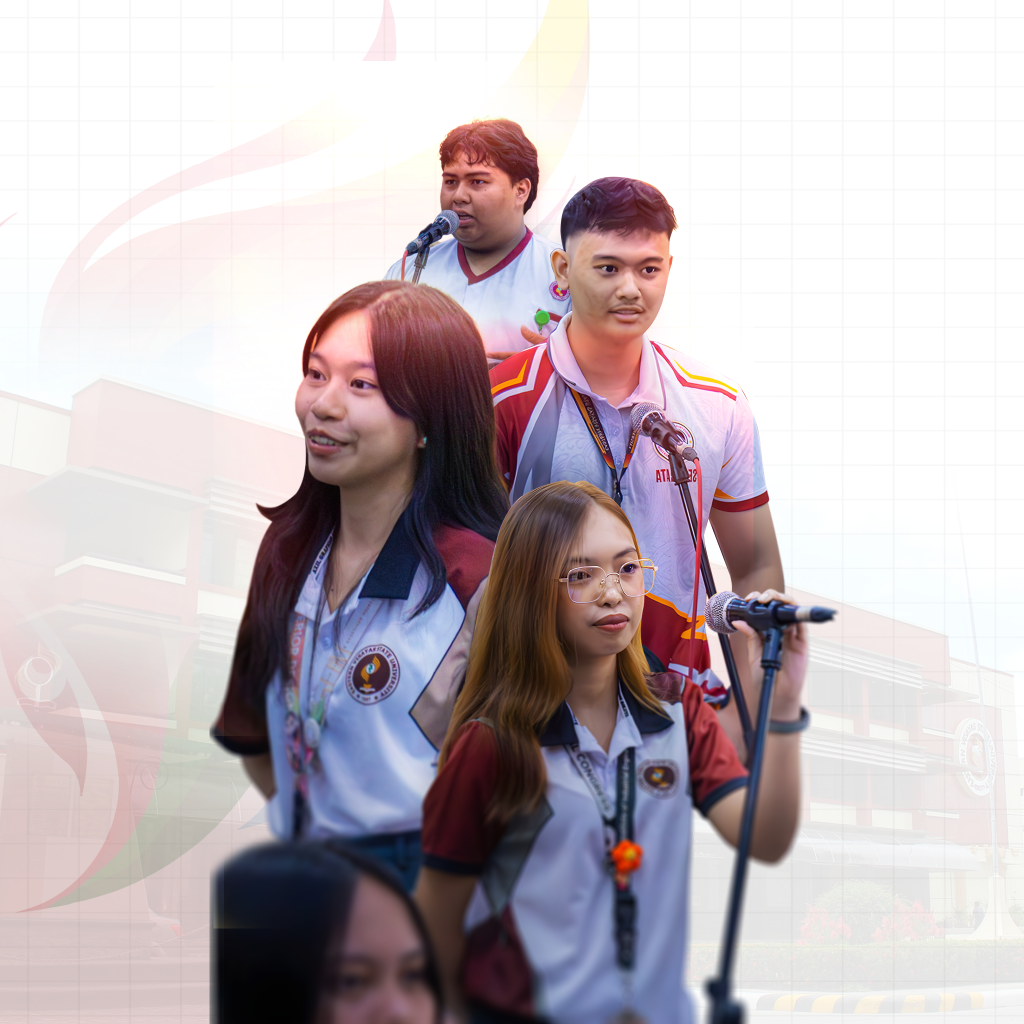
Graphics by Jhon Carl Moron
It has already been more than a century since our beloved EVSU paved its way to excellence while facing numerous challenges that have shaped what we see today. Deadlines pile up, expectations press heavily, and uncertainty drifts through hallways like an unspoken question. But when student leaders stepped forward, they did not simply carry microphones. They carried compasses, determined to navigate their school through restless waters and toward clearer skies.
In a university where academic rigor meets everyday realities, leadership is no longer ceremonial. It is necessary. It is urgent. And for the student leaders of Eastern Visayas State University, it is deeply personal.
For Cedrick Porta, Vice President of the Supreme Student Government (SSG), leadership begins with service.
“To me, the essence of student leadership is servant-leadership underpinned by altruism and pedagogical integrity,” he shared, his words deliberate and measured. “It is the art of harmonizing individual aspirations with collective welfare.”
Behind the eloquence lies a simple conviction: leadership is not about position, but about purpose. Porta views his role as a bridge, one that connects students’ unspoken anxieties to administrative action. In a campus climate where policies shape daily student life, he believes voices must not echo into emptiness.
“I intend to utilize my voice as a catalyst for systemic advocacy,” he said. “By maintaining a transparent dialogic bridge between the administration and the learners, I will ensure that student agency is not merely a formality but a primary driver of institutional policy.”
Vision frames student governance not as symbolic representation, but as democratic practice in motion. Events that gather student leaders into one forum like the HARAMPANG 2026 are more than programs; they are rehearsals for real-world responsibility. Yet even as leaders speak of governance and policy, the most urgent concern is far more human. These leaders tend to point to what many students carry silently between classes–the mounting pressure on their mental and emotional well-being.
“The most pressing imperative is the mitigation of the mental health crisis,” Porto emphasized. “Academic excellence is unsustainable without a foundation of mental fortitude.”
Across the room, another leader carries a similar resolve, though shaped by a different set of battles. For Sunshine L. Lagradilla, President of Philippine Institute of Interior Designers- Student Auxiliary Body (PIID- SAB), leadership is inseparable from compassion. Where Porta speaks of systemic advocacy, Lagradilla speaks of amplification. Her voice, she says, is an instrument, somewhat tuned to the concerns of her organization and the wider EVSU community.
“It is my duty and responsibility to amplify their voices, listen to their needs, and advocate for positive change within our university.”
For her, the significance of the gathering lies in empowerment. It provides a space where leaders do not compete for recognition but unite for representation.
“It helped student leaders to speak up for their rights and to voice out their concerns—not for personal issues, but for the betterness of the whole student body,” she expressed.
Sometimes, those concerns are as tangible as the water that pools along campus pathways. While policies and programs are discussed under bright stage lights, many students quietly wade through flooded walkways after heavy rains. Shoes soaked. Damp uniforms. Classes attended despite discomfort. For Lagradilla, this is not a minor inconvenience. It is a daily burden that demands attention.
“The most crucial issue that should be addressed is the flooding issue here at EVSU,” she said firmly. “Our school should improve our drainage systems to avoid flooding. Students are always having a hard time walking around because most of the time, their uniforms and shoes get soaked with floodwater.”
It is in these moments when abstract leadership meets concrete realities that the true weight of student voices becomes clear.
One leader calls for mental health infrastructure; another demands physical infrastructure. One speaks of democratic processes; the other of drenched corridors and resilience under gray skies. Together just like all the student leaders speak for, they sketch a portrait of leadership that is both visionary and grounded.
In times that are overwhelming, it is easy for voices to falter. It is easy to retreat into silence. Yet within the walls of the Graduate School Function Hall, something steadier emerged: a chorus of young leaders determined to transform concern into conversation, and conversation into change.
The current may be strong. The waters may be restless. But as long as there are students willing to stand at the helm, speaking not for themselves but for many, the school will not drift aimlessly.
Article by Denise Cañete