
Graphics by John Carl Acosta
Smoke from forest fires in Kalimantan, Indonesia, has crossed into Luzon, Visayas, Mindanao, and Mimaropa, pushing fine-particle pollution to unhealthy levels as the Southwest Monsoon, or habagat, carries the haze across the region.
According to the Department of Environment and Natural Resources – Environmental Management Bureau (DENR-EMB), smoke from active fires in Kalimantan is being transported toward the Philippines by prevailing southwest winds, allowing pollution generated hundreds of kilometers away to affect air quality in the country, the agency said the haze may continue affecting parts of the Philippines from September 1 to 3 if fires remain active.
Haze occurs when smoke, dust, gases, and other microscopic particles accumulate in the atmosphere, reducing visibility and making the air appear cloudy or gray. One of the main pollutants is PM2.5, a particulate matter measuring 2.5 micrometers or smaller that can penetrate deep into the respiratory and can travel deep into and lungs and may enter the bloodstream when inhaled. In this case, the primary source is the combustion of vegetation and other materials in Indonesian fires.
The worsening air quality was reflected when the Environmental Management Bureau recorded an Air Quality Index (AQI) of 117 on Monday, which was considered unhealthy for sensitive groups. The level rose to 152 by Tuesday morning and 172 by noon, reaching the “very unhealthy” range, an AQI above 100 means the air may already be harmful, especially to people with respiratory complications.
DENR-EMB said rainfall can help remove suspended smoke particles and PM2.5 from the atmosphere through a process known as wet deposition, in which raindrops capture airborne particles and bring them down to the surface. Therefore, sustained rainy conditions would generally favor a gradual reduction in haze, while drier monsoon pattern would allow smoke to travel farther and linger longer.
While the Philippines cannot directly control the fires producing the smoke, weather conditions can influence how long the haze remains over the country. The agency said air quality could gradually improve between September 4 and 6 if rainfall becomes widespread and wind patterns shift. However, conditions will ultimately depend on whether the fires in Kalimantan continue, whether new hotspots develop, and whether winds continue transporting smoke toward the country.
The Department of Health warned that haze can cause breathing difficulties, coughing, chest pain and eye irritation, and can worsen asthma and other lung conditions. Children, older adults, and people with respiratory or cardiovascular illnesses are particularly vulnerable and were advised to take extra precautions, including reducing prolonged outdoor activities and wearing well-fitting N95 masks when exposure to haze cannot be avoided.
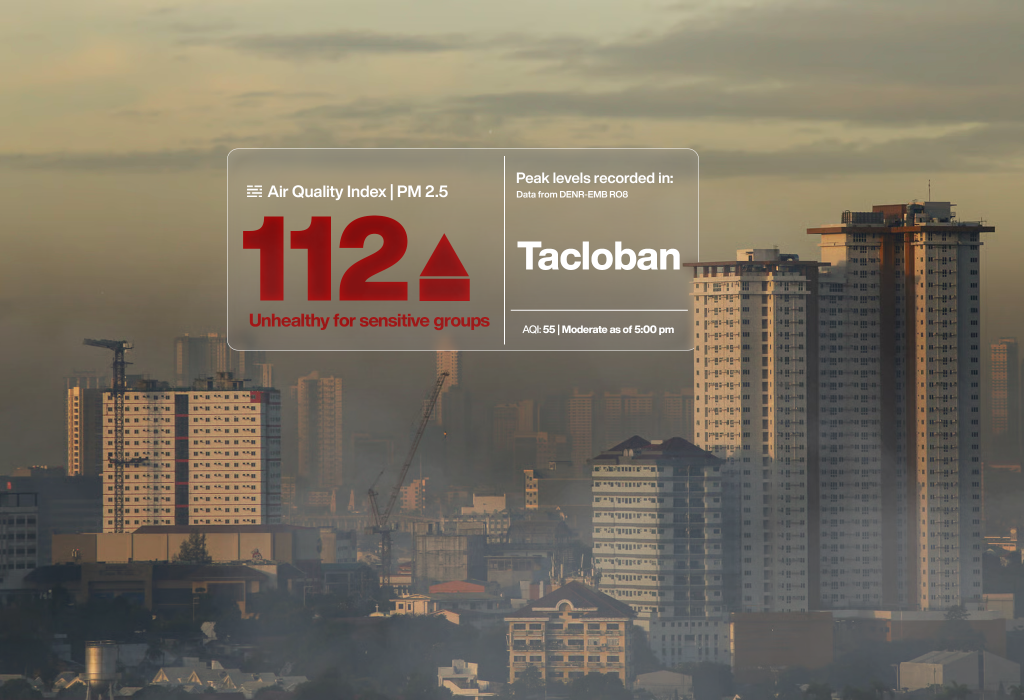
Eastern Visayas has recorded a slight increase in air pollution, according to the Environmental Management Bureau (EMB) Regional Office 8 during its 4 p.m. to 5 p.m. monitoring window of September 2. As of 5 p.m., the Tacloban Ambient Air Quality Monitoring Station recorded an AQI of 55 for PM10, classified as “moderate,” while PM2.5 reached an AQI of 112, placing it in the “unhealthy for sensitive groups” category.
Article by Kyla de Paz