
From improvised gowns and bedsheets to TikTok fame and the Fashion Design classroom, John Paul Yu – JP to those close to her and Yu Jenner to her hundreds of thousands followers – is a second-year Clothing and Fashion Design student at Eastern Visayas State University and is learning how to turn a childhood imagination into something real.
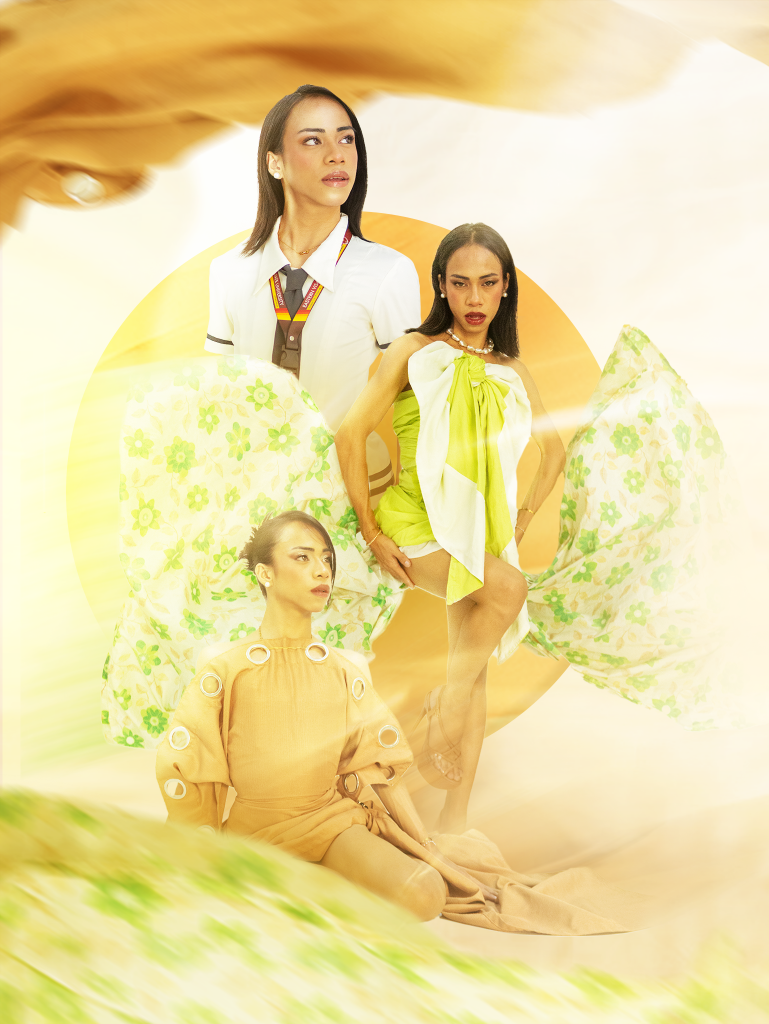
Graphics by Zean Dellera
There was a time when a curtain was not a curtain to JP. A bedsheet was not a bedsheet, either. And a blanket, the ordinary household material she found at home, could become a gown.
At around eight years old, JP would retreat to a room and turn whatever she could find into an imaginary pageant dress. She would wrap herself in a blanket, introduce herself as though she were a Miss Universe candidate, and perform the kind of pageant she had watched on television.
Sometimes, however, her father would hear her. When he appeared, the gown came off.
“Mayda kami mga taklap, and ginhihimo-himo ko hiya nga mga gown-gown, magi-introduce ako na baga hin candidate ha Miss Universe,” she recalls. “Tapos ‘pag nabati na ako nga naulpot na hi Papa, tanggal dayon tanan nga akon gown nga taklap.”
The costumes were makeshift. The pageants were imaginary. But the fascination was real.
Long before thousands of people would watch her walk in creations made from unconventional materials, JP had already been imagining herself in gowns.
She grew up surrounded by people with talents in entertainment – dancers, singers and performers – and from an early age, she knew she wanted to pursue the arts. Pageants, Barbie, modeling, and gowns became part of the world she imagined for herself.
“Han time nga na-discover ko nga I’m into arts, too, nag-start na ako pag-watch hin pageantries and mga similar stuff,” she says. “Then, I realized that I really love the concept of gowns – its design, the details, and the execution.”
For a while, she imagined becoming a beauty queen. She also once imagined becoming a flight attendant, drawn to the sophistication of cabin crew and the idea of traveling by plane.
But somewhere along the way, fashion began to feel less like something she admired and more like something that reflected who she was. “Because I do believe that fashion really embodies who you really are,” she says. “Based on your style, based on how you do your outfits. It really reflects on who you really are.”
That realization would eventually lead her somewhere she could not have imagined when she was eight: a classroom where she would begin learning how to turn those improvised gowns into real garments.
But first, there was TikTok.
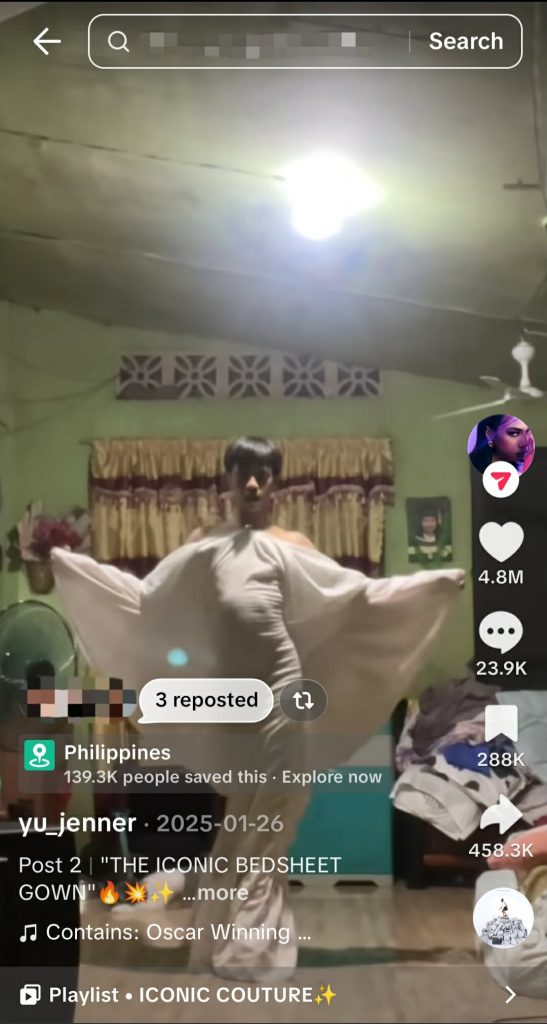
THE BEDSHEET THAT STARTED IT ALL
The pandemic gave JP time, a house to stay in and, eventually, an idea. With little to do at home, she began making DIY gowns and pairing them with pageant music. She would put on heels, walk, pose and perform.
In 2023 and 2024, much of her content consisted of ramp walks. She was creating, but she had not yet found the format that would transform her hobby into something much bigger.
That changed in January 2025. Her first viral video was not the now-recognizable Kurtina Couture. It was a creation made from a bedsheet. The response encouraged her to experiment further. Soon, viewers were suggesting other materials.
One comment in particular gave her another idea, “What if she used the curtain behind her?”
She tried it. And people responded.
The curtain became a gown. An ordinary household object became couture. What had started as experimentation became part of the identity that audiences began to associate with her. The idea was simple but deeply connected to the child she had once been – take something ordinary and make it extraordinary.
“I always dreamt of turning things from ordinary to extraordinary,” she says. This philosophy became increasingly visible through her content. The little boy who once wrapped himself in a blanket was now creating fashion in front of a digital audience.
And JP was becoming Yu Jenner. The name itself combines her surname, Yu, with Jenner, inspired by her admiration for model Kendall Jenner. She wanted to be like her.
But the identity became more than a name. Yu Jenner became the creator – the version of herself that could walk in heels, construct unconventional couture, perform for an audience and turn an idea into a spectacle.
Then people started watching.
WHEN PEOPLE STARTED LOOKING
At 17, one of her first major milestones came when she was approached for a collaboration with international fashion brand Loewe, and soon more doors began opening. She was featured by national platforms including Preview.ph, Inquirer.net and OnePH. She took part in opportunities such as the Jojo Bragais runway video challenge and was eventually featured on ABS-CBN’s Ibang Level ‘To.
For JP who had dreamed of entering entertainment, the ABS-CBN appearance carried a particularly personal meaning. “As a person na dream na maging artista, biggest dream come true gud talaga hiya for me,” she says.
Her audience grew with the opportunities. Eventually, she surpassed 700,000 followers and accumulated more than 39 million likes on TikTok. But the numbers do not fully explain what the journey meant to her. Before the growth, she had been happy imagining that even 1,000 followers would be enough.
“Honestly, diri ako na-expect na maabot ako hin sugad kadamo nga followers,” she says.
The attention boosted her confidence, but it also gave her a different understanding of what her platform could mean. She began to see herself as someone representing more than herself, particularly young people in the LGBTQ community who might still be trying to understand their own place in the world.
She wants them to embrace who they are, show what they can do and believe that their lives have purpose.
The most meaningful achievement, then, is not necessarily the brand collaboration or the media feature. It is what happens after the screen goes dark.
“The heart of people,” she says.
For JP, being able to reach people is the achievement she values most.
“If waray hira, waray ako.”
She remembers receiving comments from people thanking her for inspiring them. She remembers messages from young viewers. She remembers unexpectedly being recognized by children outside, even though they were not necessarily her intended audience.
Those moments remind her why she creates. A single video, she believes, can inspire someone else. And sometimes, that is worth more than a number on a screen.
THEN, SHE DISAPPEARED
Success, however, did not make the next chapter easy.
College arrived. And with it came academic work, responsibilities, partnerships, collaborations and leadership duties within her department. For a while, JP felt as though she was losing her place in TikTok.
“Usa gihap ito nga akon kinahahadlokan pag-enter ko han college,” she admits.
She felt she had disappeared from the industry. She did not know how to come back. She prayed, asking when she would return and what she should do. She cried. She studied hard, but at the same time felt that she was gradually becoming absent from the creative space she had built.
“Nawara ako,” she emotionally recalls. “Like diri ako maaram paano ako mabalik ha TikTok content creation.”
Then she discovered Umingle, a website similar to Omegle, and began creating content there. The experience gave her something she had been looking for: evidence that her audience had not completely moved on.
They were still there. Waiting. She realized that even when she thought she had disappeared, she had not disappeared from the hearts and minds of the people who had followed her.
That realization pushed her to try again. Her return has been gradual. So has her understanding of what it means to balance being Yu Jenner with being JP.
“Actually, makapoy. Makapoy talaga,” she says of managing everything. During periods heavy with academic work, creating becomes difficult. When schoolwork eases, she finds time to create again.
The cycle continues. And so does the balancing act.
FROM SAFETY PINS TO SOMETHING REAL
If TikTok taught JP how to turn ordinary objects into extraordinary images, EVSU is teaching her something different – how to make the extraordinary real. She chose to study fashion because she wanted to learn what content creation could not fully teach her.
Sewing.
Basic patterns.
Construction.
The technical processes behind the fashion she had been imagining and creating.
As a second-year student, she is no longer satisfied with gowns held together by safety pins. She wants to understand what comes next. “Kay I told myself na I want to turn my coutures into real ones,” she says. “From using safety pins, into a reality creation – one piece of creation.”
That distinction matters. Online, she learned to create with what she had. In school, she is learning why things are made the way they are. She is learning the craft behind the spectacle. And that process has given her a different perspective on pursuing a career.
She knows that talent alone does not instantly produce mastery. There is a process. There is learning. There is being self-taught. There is making mistakes and trying again.
“If you wanted to really pursue it, you will achieve it kun talagang pagtratrabahuan nimo.”
That may be the most important difference between the eight-year-old JP and the student she is now. The child could imagine the gown. The creator could improvise one. The student is learning how to actually construct it.
JP IS STILL JP
For her, there is a difference between JP and Yu Jenner. Yu Jenner is the name hundreds of thousands of people recognize. JP is the person underneath it – the one who studies, gets tired, worries, struggles to manage her time and keeps trying anyway.
When asked what she would say to her younger self, she does not speak only about success. She speaks with gratitude. And she apologizes, too.
“I’m so proud of you,” she tells the younger JP. She is proud because the child who once imagined becoming a designer and model is now, little by little, achieving the dream she once had.
But she also wants to remind herself that JP must never disappear behind Yu Jenner.
“JP will always be JP.”
For her, JP is the one who carries the problems. JP is the person who was there before the audience knew Yu Jenner existed. Without JP, there could be no Yu Jenner. And without the support of her family and friends, she says, she would not have made it this far.
So she thanks the younger version of herself for continuing even when things became difficult. She tells her to keep going. Her future, she believes, will be better.
STILL IN THE MAKING
There is still no final version of JP. That is perhaps the most fitting thing about her story.
She has already been a child pretending to be a beauty queen, a girl fascinated by gowns, a pandemic-era creator, a ramp walker, a viral TikTok personality, a collaborator with major brands, a media feature and a source of inspiration for people she has never met.
Yet she is still learning. Still sewing. Still studying. Still creating. Still trying to find her way back when she feels lost. Still figuring out what kind of designer she wants to become.
The difference now is that the dream has changed from something she could only imagine into something she can work toward with her own hands. The blanket has become a memory. The safety pins are only the beginning. The gown is no longer simply something she imagines. One day, she wants to make it for real.
And perhaps that is what makes JP’s story worth telling – not that she has already arrived, but that she refuses to pretend she has.
She is still becoming.
When asked what she is becoming, she does not imagine an entirely different person waiting somewhere in the future. She imagines herself.
A stronger JP. A bolder JP. But still JP.
“Be bold, be proud, and always be yourself,” she says.
It is a motto for the person she hopes to become, but it also sounds like a promise to the child she used to be: the little one hiding in a room, wrapping herself in blankets, introducing herself as a Miss Universe candidate and dreaming of a life in fashion.
She was making gowns then. She is learning to make them now. The difference is that the curtain is no longer hiding her.
Now, she steps beyond it.
And when the curtain calls, JP is still JP — still learning, still creating, still becoming.
Article by Alrey Lacaba