
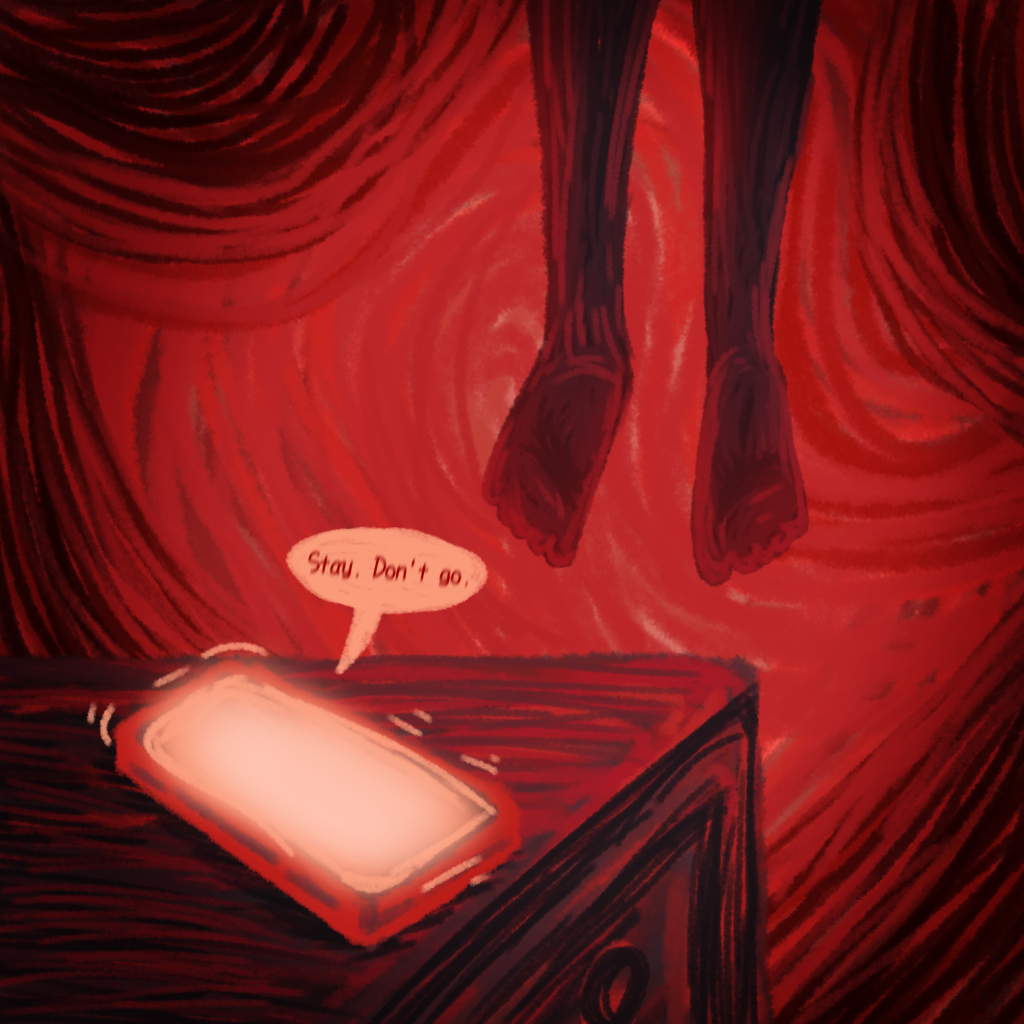
Illustration by Christian Ver Labana
Stay. Don’t go.
A phrase that shows up in nearly every suicide prevention training, every crisis line script, every pamphlet taped to a college counseling office door—two sentences that even a seven-year-old could say
And yet somehow, it was the words that kept thousands of people alive, long enough for them to see the next morning. But how can these simple words nearly have an impact on someone who’s going through a crisis inside their minds?
Suicide remains one of the leading causes of death worldwide — and the Philippines is not an exemption. The Philippine Statistics Authority recorded a 57% jump in suicide-related deaths in 2020, pushing the toll to 4,420, up from 2,810 the year before, moving suicide up the list of leading causes of death nationwide. Against numbers like that, “stay, don’t go” can feel almost naive, like bringing a flashlight to a wildfire.
Behind the statistics are common threads — depression, financial strain, unemployment, chronic illness, and relationship breakdowns — and the fallout doesn’t stop with the person lost. It ripples through families, classrooms, and communities left to process grief, guilt, and unanswered questions. But the data tells a different story than intuition does.
The moment that matters most in a suicidal crisis is rarely a grand intervention, rather it’s usually just someone else refusing to let the person go through it alone.
Picture someone in Quezon City at two in the morning, phone in hand, thumb hovering over three numbers: 1-5-5-3. They don’t dial right away. They just sit with it — the way most people do before finally reaching out. That number belongs to the National Center for Mental Health’s Crisis Hotline, and it’s been ringing more than ever. In just the first nine months of last year, NCMH logged over 7,000 suicide-related calls alone. Since the hotline first opened in 2019, it has answered more than 115,000 calls total — most of them from people between 18 and 30, the age most Filipinos are figuring out who they’re becoming, and how much of it they can carry alone.
People rarely call and say they’re thinking of suicide right away. It usually starts smaller — they say they’re anxious, or a relationship just ended, or things at home aren’t good. The real pain often comes out only after they’ve been talking for a while. And through all of it, a trained counselor is doing only one simple thing: staying on the line, saying some version of stay, don’t go, and meaning it.
An NCMH specialist explained it simply,
“What helps most is presence, you being there for them, without judgment,” said Dr. June, an NCMH medical specialist, in a recent interview.
That’s the quiet theory behind every one of those 115,000 calls, they didn’t try to fix them, but they just became the voice that they needed.
But it shouldn’t always be the hotline’s job, because each of us can also make that kind of difference in someone’s life. You walk into the kitchen and you notice that your sister has been quieter than usual. When you ask her if she is doing okay, it takes her a few seconds before she looks at you and answers “I’m fine.”
Her tone was unusually lower, you notice the bloodshot eyes and how she hunched her back like she was feeling a weight in her shoulders. This is not the part where you walk away and shrug it off, rather it’s where you offer her a cup of warm coffee, sit by her and ask “Are you sure?”.
It’s not a clinical skill that you need to learn, it’s a matter of being the person who makes sure they know they are seen, heard and cared for. It’s refusing to let the person slip out the door quietly without ever acknowledging how they’re feeling.
That refusal matters more for some people than others. Among Filipino students, the numbers hide behind ordinary school days — one in ten reportedly carries serious mental health struggles, and suicide has quietly climbed the list of what takes young lives too soon. Among workers and adults, the danger isn’t always the struggle itself but the silence around it — the country has less than one mental health worker for every 100,000 Filipinos, so even someone who finally decides to ask for help can find no one on the other end. And among LGBTQ+ Filipino youth, the weight is heaviest: three in four have seriously considered suicide, nearly half have attempted it, and more than a third did so within just the past year — numbers that say less about who they are than about how little the world has made space for them to stay.
“Stay, don’t go” is a beautiful sentence. It’s also not enough on its own — it needs providers who actually exist, systems that respond in time, and follow-through long after the hard conversation ends.
Every person who has ever talked to someone through the worst night of their life describes some version of the same small, undramatic act: they didn’t fix anything. They didn’t have the perfect words. They just stayed on the phone, or stayed in the room, or stayed in silence after the hard question, long enough for the crisis to loosen its grip a little. Not forever. Just long enough.
That’s the quiet, stubborn logic underneath an entire field of research, an entire hotline, an entire movement built to keep people alive: that presence itself is a kind of medicine. Those two words, repeated by enough people, in enough rooms and cars and late-night phone calls, can be the difference between someone leaving and someone staying to find out what happens next.
Stay. Don’t go. It isn’t much of a sentence, but it might be the only one that matters the most to them.
Article by Karyll Mangilaya