
Graphics by Uriel Astorga
The student body of Eastern Visayas State University (EVSU) – Main Campus approved the proposed 2026 Constitution and By-Laws (CBL) of the Supreme Student Government (SSG) following a plebiscite held on October 28-29.
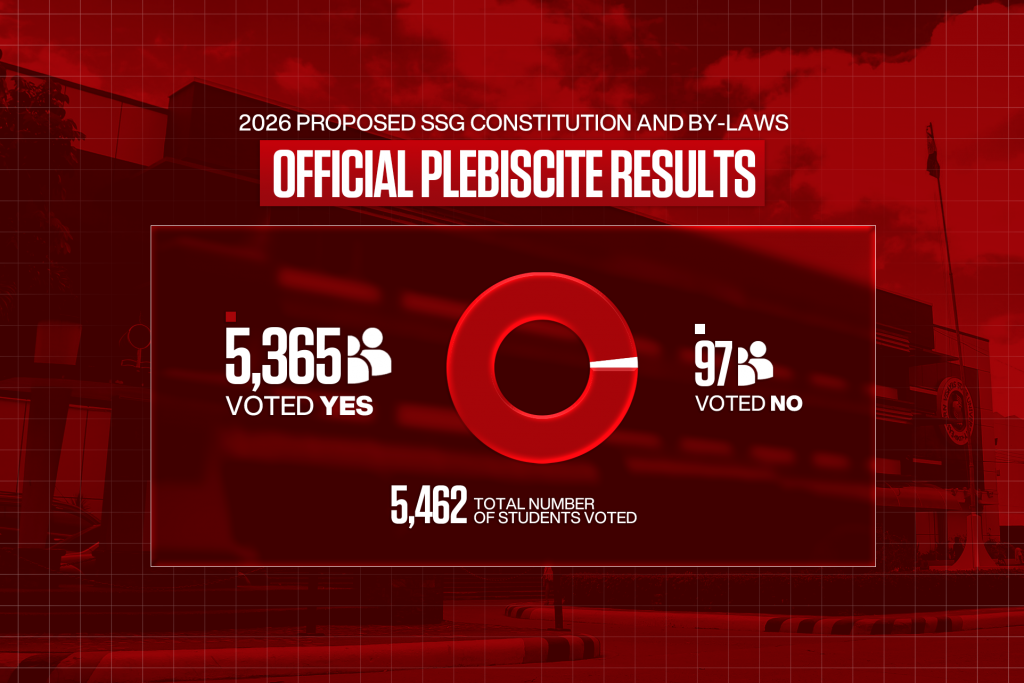
Of the 5,462 students who cast their votes, 5,365 voted YES, while 97 voted NO, surpassing the required simple majority of 50 percent plus one YES vote among the total votes cast.
With no fixed number of votes required, the proposed CBL secured approval by meeting the established majority threshold, reflecting strong student support for the revisions.
The proposed 2026 CBL seeks to replace the university’s 2007 student government constitution, which has served as the basis for the organization’s structure, operations, and student representation.
The revisions aim to address the evolving needs of the student body by introducing changes to the structure, responsibilities, and accountability mechanisms of the EVSU-SSG, with the goal of establishing a more responsive, inclusive, and transparent student government.
Among the major changes are the proposed establishment of a bicameral Legislative Assembly composed of the Senate and House of Representatives, an independent and autonomous Commission on Elections (COMELEC), and a revised set of executive standing commissions.
The proposed CBL also strengthens provisions on student rights, academic freedom, financial transparency, disciplinary measures, and accountability.
Additionally, it expands the Council of Leaders and outlines transition provisions to guide the eventual shift to the proposed government structure while respecting the lawful terms of incumbent officers.
In an interview, SSG President Hon. Christine Jane Lawsin emphasized that the revisions aim to keep the student government’s governing laws relevant and responsive to the university’s current structure and the needs of its student body.
“Actually, the primary purpose talaga of amending/revising the 2007 EVSU SSG Constitution and By-Laws is to ensure that the governing laws of the SSG remain relevant, responsive, and aligned with the current structure, needs, and realities of the University and the student body. Through this revision, we aim to address provisions that may already be outdated, clarify policies that may have caused confusion, and establish a more organized and effective system of student governance,” Lawsin said.
The approval of the proposed CBL marks a significant step in the SSG’s efforts to update its governing framework and make its policies more responsive to the needs and interests of the student body.
Article by Sarah Lorica