
Graphics by Jayson Igarta
A Strong El Niño is currently active in the tropical Pacific and is expected to intensify into a Very Strong El Niño between the September-December 2026 season, according to the Philippine Atmospheric, Geophysical and Astronomical Services Administration (PAGASA).
The Department of Science and Technology (DOST) agency said the phenomenon is expected to persist through the first half of 2027, increasing the likelihood of below-normal rainfall, dry spells and drought in some parts of the Philippines.
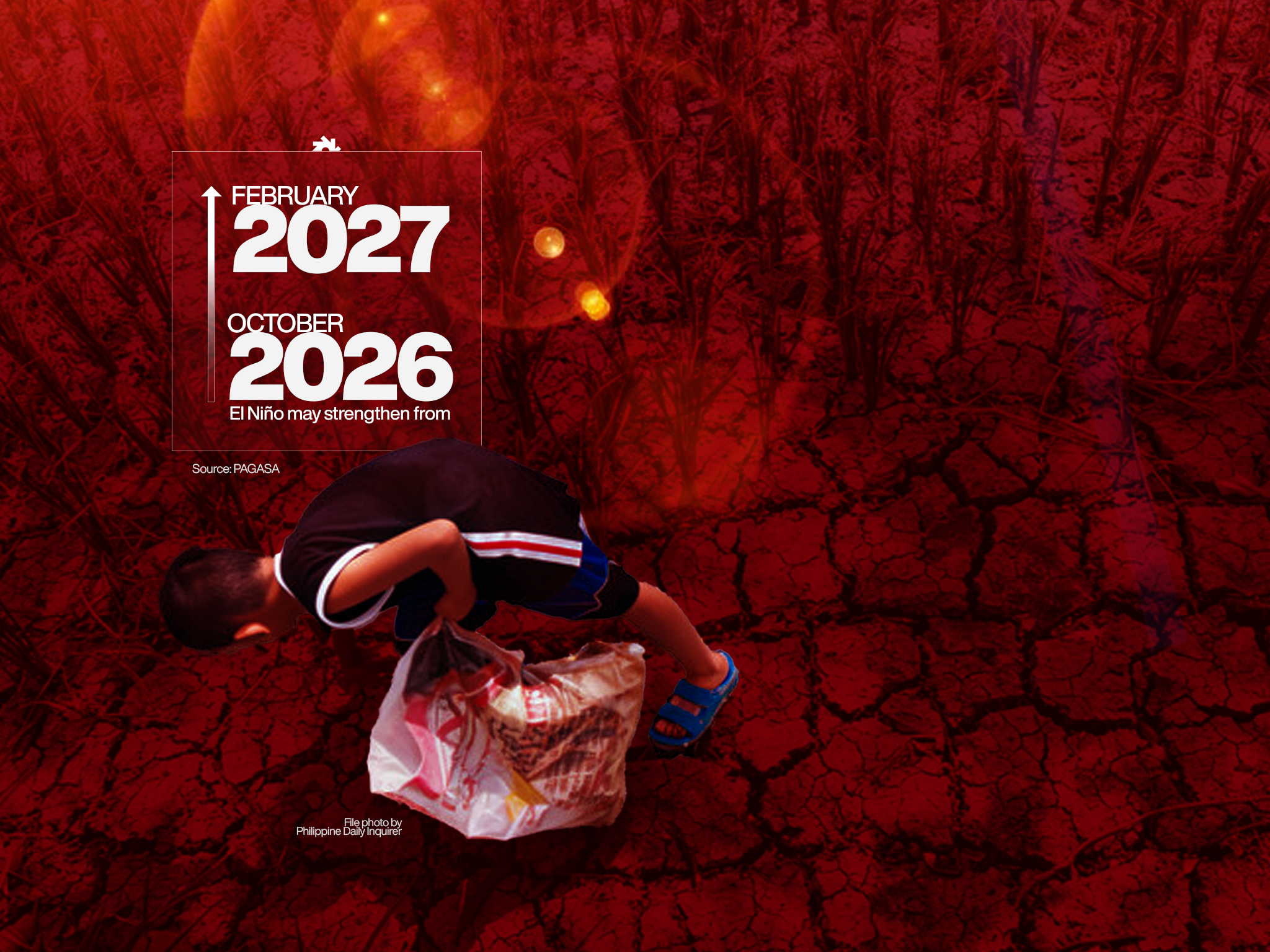
PAGASA’s September 2026 outlook indicates that El Niño is expected to strengthen from October 2026 to February 2027 and may peak toward the end of 2026. The developing climate pattern could increase the likelihood of warmer-than-usual temperatures and below-normal rainfall in some areas of the country.
El Niño is the warm phase of the El Niño-Southern Oscillation (ENSO), a climate pattern involving interactions between ocean temperatures and the atmosphere over the tropical Pacific that can influence weather and climate conditions around the world.
The phenomenon develops when sea surface temperatures in the central and eastern tropical Pacific become warmer than average, accompanied by changes in atmospheric circulation, including weakened trade winds.
El Niño does not occur on a fixed schedule. According to the National Oceanic and Atmospheric Administration (NOAA), El Niño and La Niña events occur on average every two to seven years, while El Niño episodes typically last nine to 12 months. They generally develop between March and June, reach peak intensity between December and April, and weaken between May and July, although their timing and duration can vary.
For the Philippines, the strengthening El Niño increases the likelihood of below-normal rainfall, which may lead to dry spells and drought in some areas. PAGASA’s September outlook identified Northern Luzon, Zambales, Bataan, Davao del Sur, Davao Occidental and Sarangani among areas expected to experience below-normal rainfall.
However, El Niño does not mean that the entire country will immediately experience dry conditions. PAGASA noted that western parts of the Philippines may still experience above-normal rainfall during the Southwest Monsoon, or Habagat.
As El Niño strengthens, PAGASA will continue monitoring climate conditions that may affect the country and issue updates as necessary.
Article by Kevin Jemina